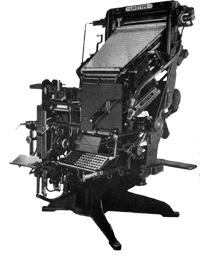
Who is credited with the invention of the typewriter?
Christopher Shole
What is a "stenographer"?
Some one good in writing down spoken words. Post an example of Shole's typewriter.
Why did Sholes send a prototype of his typewriter to Clephane?
He thought that stenographers would be one of types of people to extensively use it.
After the typewriter began production, why did Clephane pursue another machine?
It still took a long to to typeset and copy notes.
Who spent a year redesigning Clephane's typesetting machine?
Ottmar Mergenthaler
What is meant by "typesetting"?
Arranging text in a readable format. Post an example of Linotype Machine.
How does the Linotype Machine differ from the typewriter?
Type was cast from a metal matrix.
How did this machine change the newspaper industry?
Type could be set for more pages on a daily basis.Post an example of a Linotype keyboard.
How did the keyboard of the Linotype Machine differ from keyboards that we use today?
There was not shift key, so uppercase letters had separate keys than lowercase letters. Post an example of a Linotype slug.
What is a slug?
An assembled line of type for the linotype machinePost an example of a person operating a Linotype Machine.
Why is the Linotype Machine the greatest advanced in printing since movable type?
It allowed type to be set mechanically rather than by hand.
What is Johannes Gutenberg credited with?
Inventing the printing press, a device which could print with movable type.
Post a photo of the Gutenberg Press.
How did the printing press work?
Ink was rolled over the raised surface of movable hand-set block letters held within a wood form. The form was pressed against a sheet of paper.
What motivated Gutenberg to find a better way of creating books?
His observance of the work of goldsmiths and jewelers and his love for reading.
Why did Gutenberg experiment with metal type versus wood type?
Woodcuts were not durable, and new ones had to repeatedly be made.
Post an example of movable type in a type case.
What is moveable type?
The system of printing that uses moveable components to reproduce the elements of a document.
What is a matrix?
A hard metal punch shaped like a character that is hammered into a copper bar.
What ink did Gutenberg develop that he used specifically for the printing press?
Oil-based ink
What is paper made from? Where did paper originate?
Paper is made from wood pulp. It originated from China.
What is a "substrate"?
A substance underneath something on which a process occurs.
Who did Gutenberg seek to help with the invention of the press? Close to the end of the 5 years, what happened?
What was the first book he printed?Post an example of this book.
Johan Fust and Peter Schaffer. Gutenberg was sued by Fust and made to hand over everything to Fust. The first book he printed was the Bible.
How did the Gutenberg Press impact communication?
It perfected script and made it easier to read. Books were made more rapidly. Current information could also be shared locally and around the world. It also increased the literacy rate and reduced the cost of books.
Who introduced the printing press to England?
William Caxton
What was the early form of newspapers?
Trade newsletters
When was the first news weekly published? What was it called?
The first news weekly was started in Boston, Massachusetts; it was called The Boston Letter. What kind of press was built in the US in the mid 1800s? The steam powered rotary press.
Post an example of a 1930s printing press.
By the late 1930s, presses had increased in efficiency and were capable of 2,500 to 3,500 impressions per hour. What is meant by "impression"?
The act of pressing one thing onto the surface of the other.
Which printing process is the Gutenberg press an example of? Briefly describe the process? The Gutenberg press is an example of relief printing. Movable type was put into the press, ink was spread over the type, and paper was placed on top. The press directly applied the pressure needed to transfer the ink to the paper.
Post an example of an intaglio press.
What is intaglio printing and how is ink transferred? Intaglio printing is called printmaking. The image area is etched onto the plate surface. Ink is then applied and rubbed with a cloth in order to remove excess. Damp paper is then placed on top, and pressure is applied to transfer the ink.
Post an example of a screen (porous) printing press.
What is porous printing and how is ink transferred? Porous printing is a basic stencil process. Ink is transferred by forcing it through open mesh areas in an image carrier.
Post an example of a lithography printing press.
What is lithography and how is ink transferred? Lithography is printing from a flat surface. Drawing is done with greasy ink, and water is applied. When ink is spread on top, it is applied to the greasy parts, but not to the watery parts.
Post an example of a offset lithography printing press.
What variation of lithography is used by the commercial printing industry today?
Offset lithography.
How do printing presses used today compare to the Gutenberg Press?
One does not have to do manual hand-work to operate a printing press anymore.
Describe four-color process printing using CMYK?
Four colors are used in CMYK printing. They are cyan, magenta, yellow, and black. The more colors are added, the dark the result becomes. Combining cyan, magenta, and yellow together creates black. The absence of all 3 of them is white.
Post an example of a scroll.
What were the drawbacks of the scroll?
Readers could only read the text in the order that it was written.
Post an example of a codex.
What is a codex?
A covered and bound collection of hand bound pages.
"Codex" is derived from the Latin meaning "block of wood". Why?
Wood was used to create a codex.
What is the difference between "sequential access" and "random access"?
In sequential access, the text must be read in the order in which it is written, and in random access, the information can be found by looking anywhere.
What were the advantages of using the codex?
It allowed for compactness, sturdiness, and ease of reference. It was also more portable.
What helped spread the use of the codex?
The rise of Christianity
What replaced papyrus? Describe the process used to create it?
Papyrus was replaced with parchment. Parchment was created from animal skin like cows, and sheep. The hair and fat were removed from the skin, and the skin was straightened out. The hide was then soaked in water, and calcium, flour, and salt were added. Finally, the skin was stretched, flattened out, and dried.
What is vellum?
Finer qualities of parchment made from the skin of young calves.
Name several examples of current technology that utilizes the format of the codex?
Digital books like the Kindle and iPad
What led to a period of cultural and economical deterioration?
The decline of the Roman empire.
Post an example of an illuminated manuscript.
Who began creating books by hand, taking the creation to an art form?
Monastic monks
What does "illumination" refer to? What was included in this ornamentation?
'Illumination' refers to the borders, illustrations, and ornamentation added to each page of text. Ornamentation included the initials of chapters or paragraphs. Paintings in margins, borders, and around text were included in this ornamentation as well. What tool was used for creating the illuminated manuscripts?
Natural quill opens.
Why were these manuscripts reserved for religious purposes?
The work was very hard and laborious
What is craftsmanship? Why is it important?
Craftsmanship is the artistic expertise that is used to create a work. It is important because it makes a work look professional and neat.

What was the basis of the Roman uppercase alphabet?
A variant of the Greek alphabet.What were the purposes of the formal and informal styles of lettering?
A rigid, formal style was used for manuscripts and important documents while a quicker, informal style was used for letters and routine types of writing.
Why is the Roman alphabet the most widely used and what contributions did it make?
It started the usage of the baseline in typography.It started the concept of perfectly aligning text in rows. This alphabet is most widely used because it conveniently allows for uppercase and lowercase letters.
From where did serifs originate?
It originated with the carving of words into stone.
When and where did lowercase, or minuscule, letters develop?
It originated in Greece in 7th century.
What is a ligature and why were they utilized?
A ligature is when two identical letters seem to come together in a piece of text. They were utilized to improve the appearance of characters that came together.
Post an example of the Roman alphabet in visual form.

How did Greeks come in contact with the Phoenicians?
The Phoenicians traveled to Greece and frequently made trade agreements with the Greeks.
How was the Greek adaptation of the alphabet different from its predecessor?
Several consonants were adapted as vowels. Also additional letters were added.
Why is the Greek alphabet considered to be the world's first true alphabet?
It gave rise to many of the world's other alphabets, including the Latin alphabet.
Name several similarities and differences between the Greek and modern English alphabets?
Letters like alpha, beta, iota, and sigma are similar in structure to the letters like 'a', 'b', 'i,' and 's'. Some letters like lambda look completely different than anything in the modern English alphabet.
Post an example of the Greek alphabet in visual form.
 The Phoenician alphabet is based on what principle?
One sign represents one spoken sound.
Describe the shape of the letters and what tool created them?
The letters were mostly angular and straight and created by a stylus.
What two reasons made the Phoenician alphabet so successful?
It had simple characters. This simplicity allowed it to be used in multiple languages. It also got rid of class divisions between royalty and common people.
What long term effects on the social structures of civilizations did the Phoenicians have with the creation of their alphabet?
Class divisions disappeared. Other cultures began using it as well.
Post an example of the Phoenician alphabet in visual form.
In the sixth century BC, what three civilizations invaded Egypt?
Persians, Greeks, and Romans
Post an example of the inside wall(s) of an Ancient Egyptian temple.
What was discovered on the inside of the temples?
Carved and painted images were found on all of the walls and surfaces.
Scholars believe that Ancient Egyptians were inspired and influenced by which written language?
Cuneiform
What is the difference between logographic and alphabetic elements?
Logograms are visual symbols representing ideas or objects while alphabets have phonetic variations.
The term Hieroglyphic derived from what two Greek words?
Hiero (sacred) and Glyphic (engraving or writing)
What is a scribe?
Someone who writes in hieroglyphics.
Who else was trained to read and write? Why?
Military leaders so that they could communicate well in battle.
Post an example of hieroglyphics on papyrus.
What is papyrus and how was it made?
It is a substrate, and it is made from reeds found in Egypt. Wet reeds were placed criss-cross over each other and dried. They were then rubbed with stones until they were flat and smooth.
What is a substrate?
A substance underneath something on which a process occurs.
What were the Books of the Dead?
They had instructions and spells for helping important people like the pharoah in the afterlife.
How did Ancient Egyptian hieroglyphics become a forgotten language?
Non-Christian temples were closed down by Theodosius I. Eventually all of the people who could read or write the hieroglyphics disappeared.
Post an example of the Rosetta Stone.
What is the Rosetta Stone? Where was it discovered?
The Rosetta Stone is a big stone that helped decipher Egyptian hieroglyphics. It was discovered in the Egyptian region of Rosetta by the soldiers of Napoleon Bonaparte.
What three languages are included on the stone?
Egyptian hieroglyphics, Demotic, and Greek
Why couldn't the text on the Stone be deciphered?
A chunk of the stone was missing, and none of the three texts were complete.
Who finally deciphered the text? What was his breakthrough?
Jean Francois Champolion. He was able to match up the hieroglyphic symbols with the Greek name of the Egyptian Pharoah Ramses.
Why does the interpretation of the Rosetta Stone have such significance?
It helped us learn more about the ancient Egyptians and Egyptian hieroglyphics.